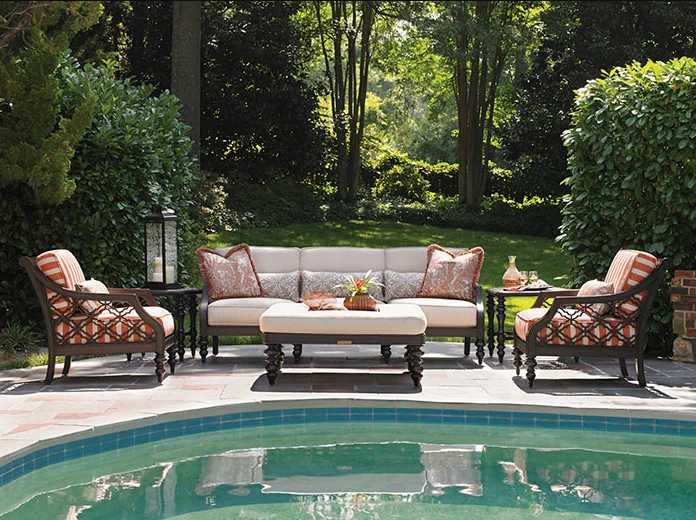
Tommy Bahama Home and Tommy Bahama Outdoor Living are two distinct furniture lines under the same Lexington Home Brands licensing umbrella. The Tommy Bahama Home collection is built for indoor use with kiln-dried hardwood frames, traditional joinery, and natural materials like rattan and raffia. The Outdoor line is engineered for weather, with marine-grade aluminum frames, all-weather wicker, and performance fabrics designed to handle sun, rain, and humidity year-round.
Both lines share the same design DNA and lifestyle storytelling, but they’re not interchangeable. This piece walks through where the differences matter, when to choose each, and how the two lines work together in California homes with strong indoor-outdoor flow.
What Each Line Actually Is
Tommy Bahama Home is the indoor furniture line. It covers bedroom, living room, dining, and home office across collections such as Bali Hai, Sunset Key, Twin Palms, Royal Kahala, Ocean Club, Key Biscayne, Royal Palm, and Island Estate. Pieces are built for daily indoor use and aren’t engineered to handle weather. The line shares construction principles with the broader Lexington Home Brands portfolio: solid hardwood frames, mortise-and-tenon joinery, dovetailed drawers, and accent materials like woven raffia, leather-wrapped rattan, capiz inlay, and stone tops.
For a full breakdown of the indoor line, see the Tommy Bahama Home furniture overview, or the deeper look at Tommy Bahama bedroom furniture for California homes for primary suite specifics.
Tommy Bahama Outdoor Living is the patio furniture line. It covers seating, dining, fire pits, accessories, and complete outdoor room solutions. The pieces use marine-grade extruded aluminum, all-weather wicker (synthetic woven fibers engineered for UV and moisture), and performance fabrics. Tommy Bahama is one of the leading brands in the outdoor furniture category, and the line has expanded considerably over the past decade as outdoor living has become a major part of how American homes are designed.
For more on styling Tommy Bahama Outdoor Living specifically, the styling ideas with Tommy Bahama outdoor furniture post covers the outdoor side in detail.
Construction Differences That Matter
The difference between the two lines isn’t aesthetic. It’s structural.
Frames.
- Indoor: Kiln-dried hardwood, with mortise-and-tenon joinery in casegoods. Wood is selected for grain quality and dimensional stability in a controlled indoor environment.
- Outdoor: Extruded aluminum or powder-coated metal. Some pieces also use wood, but the species (teak, ipe, or weather-resistant alternatives) is chosen specifically for outdoor durability.
Surface materials.
- Indoor: Real wood veneers, woven raffia, natural rattan, capiz shell, honed travertine.
- Outdoor: All-weather wicker (synthetic), powder-coated aluminum, weather-resistant stone or porcelain composite, teak.
Upholstery and cushions.
- Indoor: Frames built with corner blocks, eight-way hand-tied or pocketed coil springs, high-resiliency foam wrapped with down or down-alternative. Fabrics include indoor-rated cottons, linens, leathers, and performance options.
- Outdoor: Cushion cores designed to drain and dry. Fabrics are Sunbrella, similar acrylics, or proprietary performance textiles engineered for UV resistance and moisture handling. Most outdoor cushions can stay outside in light rain and recover quickly.
Hardware.
- Indoor: Brass, bronze, and other hardware finishes selected for visual signature.
- Outdoor: Stainless steel or marine-grade hardware that resists corrosion in sun and salt air.
If you put indoor Tommy Bahama Home pieces outside, even on a covered patio, you’ll see the consequences within months. Wood will swell, finishes will check, raffia and rattan will dry out and break down, and upholstery will absorb moisture and develop mildew. The reverse problem (outdoor pieces inside) is less destructive but the aesthetic mismatch is usually obvious.
When to Choose Each
The simple rule: indoor stays inside, outdoor stays outside (or under a covered structure with reasonable weather exposure). But the question of which line to invest in depends on how the home is used.
Choose Tommy Bahama Home when:
- You’re furnishing interior rooms (bedroom, living room, dining room, office).
- You want the construction quality and material depth of upper-end indoor furniture.
- You plan to keep the pieces for fifteen years or more.
- You want customization options across hundreds of fabrics and finishes.
Choose Tommy Bahama Outdoor Living when:
- You’re furnishing a true outdoor space (patio, deck, pool area, outdoor dining room).
- You need furniture engineered for sun and weather.
- You want the design language to extend from your indoor rooms to your outdoor spaces.
- You entertain outside and need furniture that can handle frequent use without constant covering.
The California Room and the Indoor-Outdoor Blur
California homes increasingly feature what builders call the “California room,” a covered outdoor structure that functions as an extension of the indoor living space. As one piece on the California room concept describes, these rooms typically have a roof and partial walls, retractable glass door systems, and amenities like fireplaces, kitchens, and televisions.
This is the gray zone where the two Tommy Bahama lines intersect. A California room with full weather protection (roof, walls, sometimes screens or retractable doors) can hold indoor furniture if the buyer is comfortable with some exposure. A more open structure (a covered patio with no walls) needs outdoor-rated furniture even though the roof keeps direct rain off.
Common configurations in Agoura Hills and the surrounding Conejo Valley:
- Fully enclosed California rooms sometimes use indoor Tommy Bahama Home pieces, particularly the more substantial collections like Twin Palms or Royal Kahala.
- Covered but open patios call for Tommy Bahama Outdoor Living. The performance fabrics and weather-resistant frames hold up to the conditions.
- Open patios and pool decks require outdoor-rated furniture. Even in California’s mild climate, sun and irrigation overspray will damage indoor pieces quickly.
How the Two Lines Coordinate Visually
One of the strengths of buying within the Tommy Bahama family is that the indoor and outdoor lines are designed to coordinate. Color palettes, finish references, and silhouettes share enough DNA that an indoor living room and an adjacent outdoor patio can read as one continuous space.
A few coordination strategies that work well:
- Use the same fabric story. If the indoor sofa is in a sun-bleached linen-look performance fabric, the outdoor seating can use a similar tone in Sunbrella for visual continuity.
- Match wood tones approximately. A Bali Hai indoor coffee table and a teak outdoor dining table won’t be identical, but the warmth should feel consistent.
- Repeat hardware finishes. Aged brass hardware on the indoor pieces, oil-rubbed bronze details on the outdoor pieces, both reading as warm metals.
- Echo the silhouettes. Lower-profile, relaxed silhouettes indoors should be matched by lower-profile relaxed silhouettes outdoors. Avoid putting modernist outdoor pieces against traditional indoor furniture.
For more on the philosophy behind island-inspired outdoor styling, the original Tommy Bahama outdoor styling post is a good reference for the outdoor side of the brand.
Pricing Comparison
The two lines occupy different price tiers when measured per piece, partly because the materials and engineering required for outdoor durability are different.
| Category | Indoor (Home) | Outdoor (Outdoor Living) |
| Sofa or sectional | $4,500 to $9,500 | $4,000 to $8,500 |
| Lounge chair | $1,500 to $3,500 | $1,800 to $3,500 |
| Dining table (8-seat) | $4,500 to $7,500 | $4,000 to $6,500 |
| Side or accent table | $1,500 to $3,000 | $1,200 to $2,500 |
The pricing is broadly comparable, with outdoor pieces often slightly less expensive on per-piece basis but requiring different long-term maintenance considerations.
Choosing Between the Lines for a Specific Project
For homeowners furnishing a primary residence with both indoor rooms and meaningful outdoor space, the right answer is usually both. The Mark Thomas Home design team works with clients across both lines and can plan furniture across the whole home, ensuring that the indoor and outdoor pieces coordinate visually and functionally.
A showroom visit is the fastest way to see both lines in person. Tommy Bahama Outdoor Living is also worth seeing live: the all-weather wicker and performance fabrics have improved considerably over the past decade and look almost indistinguishable from indoor materials at first glance. For California homeowners with strong indoor-outdoor flow, choosing within the Tommy Bahama family across both lines is one of the cleaner ways to get visual consistency across the whole property.